

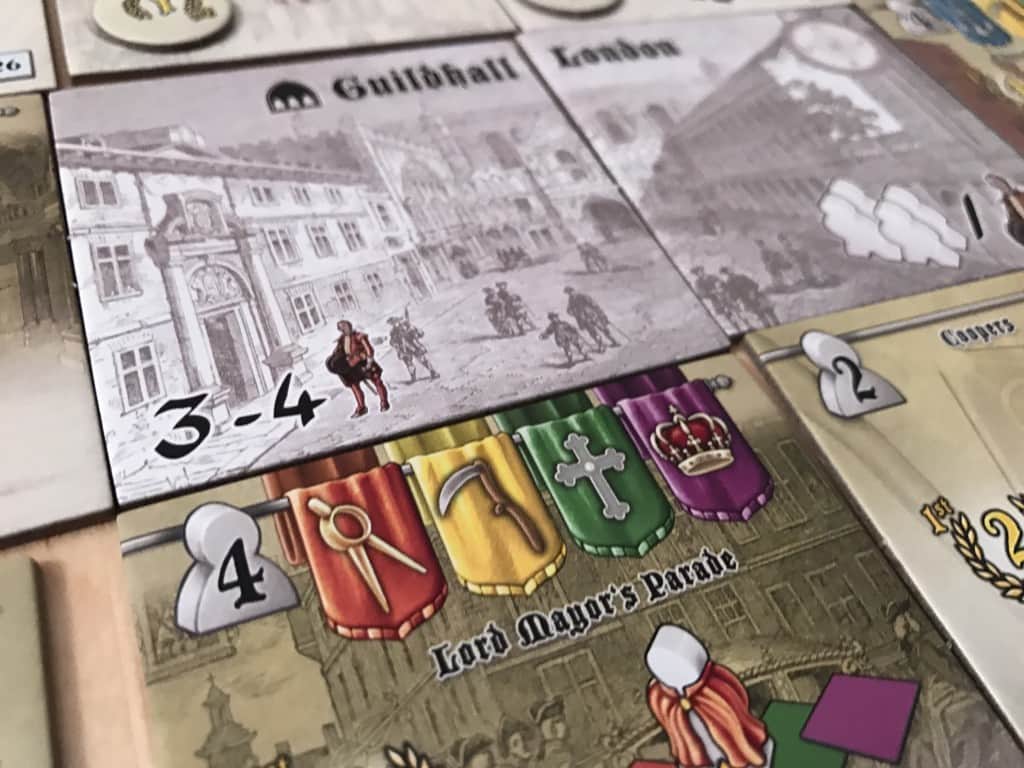
I like iconography, I really do. The non-standard hieroglyphs at the heart of some of the most replayable board games on the market today are fun to learn and even more fun to master, but they also represent one of the steepest barriers to entry in gaming. Guilds of London is such a game, and the steepness of that curve very nearly stifles what is otherwise an intelligent, fun game.
Tasked with placing your liverymen in specific guilds, graduating them to the status of master, and building influence over the immense and incredibly powerful order of guilds in late medieval and early modern London, players will be taking varied actions throughout the game to generate victory points. It’s these varied actions, and the sheer volume of options at your disposal that make the game good, but also potentially overwhelming.
How Guilds of London Plays
Guilds of London is designed for 1-4 players, but in reality it plays very differently for 1, 2, and 3-4 players. So for the sake of brevity (and clarity), this review will focus on the “base” game – the 3-4 player core that makes up the rule book. This is how you’ll want to play the game.
The game consists of 15 rounds. During each round, players will use cards in their hand to do one of three things:
- Recruit liverymen – this can be done with any card in your hand
- Move liverymen – this can be done with any card matching the destination to which you are moving.
- Use an ability – every card in the game has a different ability printed on it, along with a cost for executing that ability. Like San Juan or Race for the Galaxy, the cost is paid in cards – there is no currency component.
The goal of this is to move your liverymen to different guild tiles on the table and claim a majority. Each tile has a minimum number printed in the upper left corner – reach this threshold and the tile is eligible for scoring. There is a universal Beadle meeple that moves around the tableau and counts toward the goal. There are also neutral liverymen that you’ll be able to play to replace opponent liverymen and benefit yourself in establishing a majority.

In other words, there will be much manipulation of the play space to reach the majorities for which you are aiming. It’s a bit of a puzzle at times – and the best kind because you can really play circles around your opponents with a long game strategy, but not so much that they can’t mess back at any time.
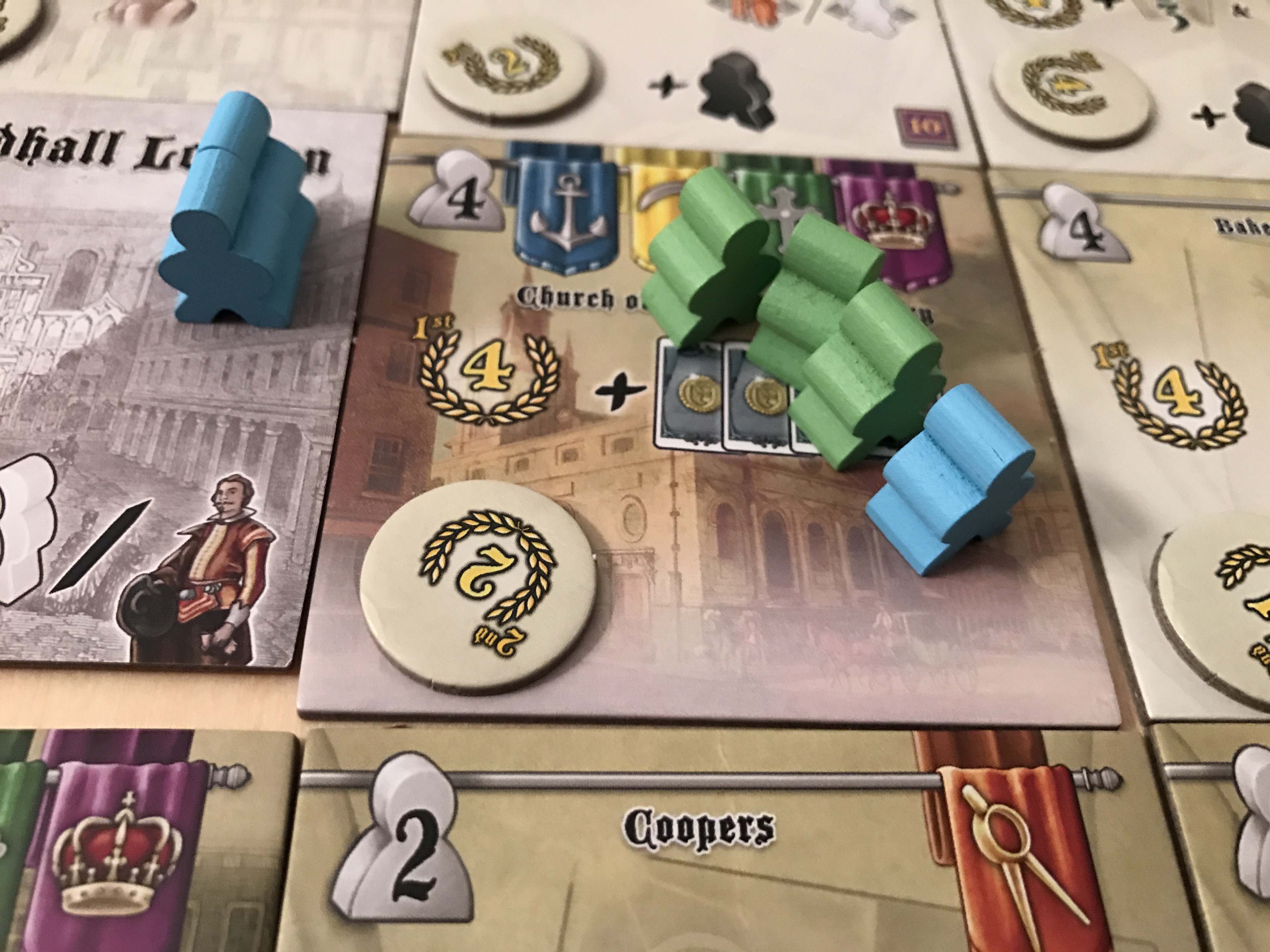
When the minimum level triggers for these tiles, they will score at the end of the round. Scoring usually awards victory points to first and second place (second place is determined randomly by tiles you’ll place as you place tiles). There are also bonuses such as extra cards, Mayor cards (end of game bonus cards), and new meeples (both player color and neutral).
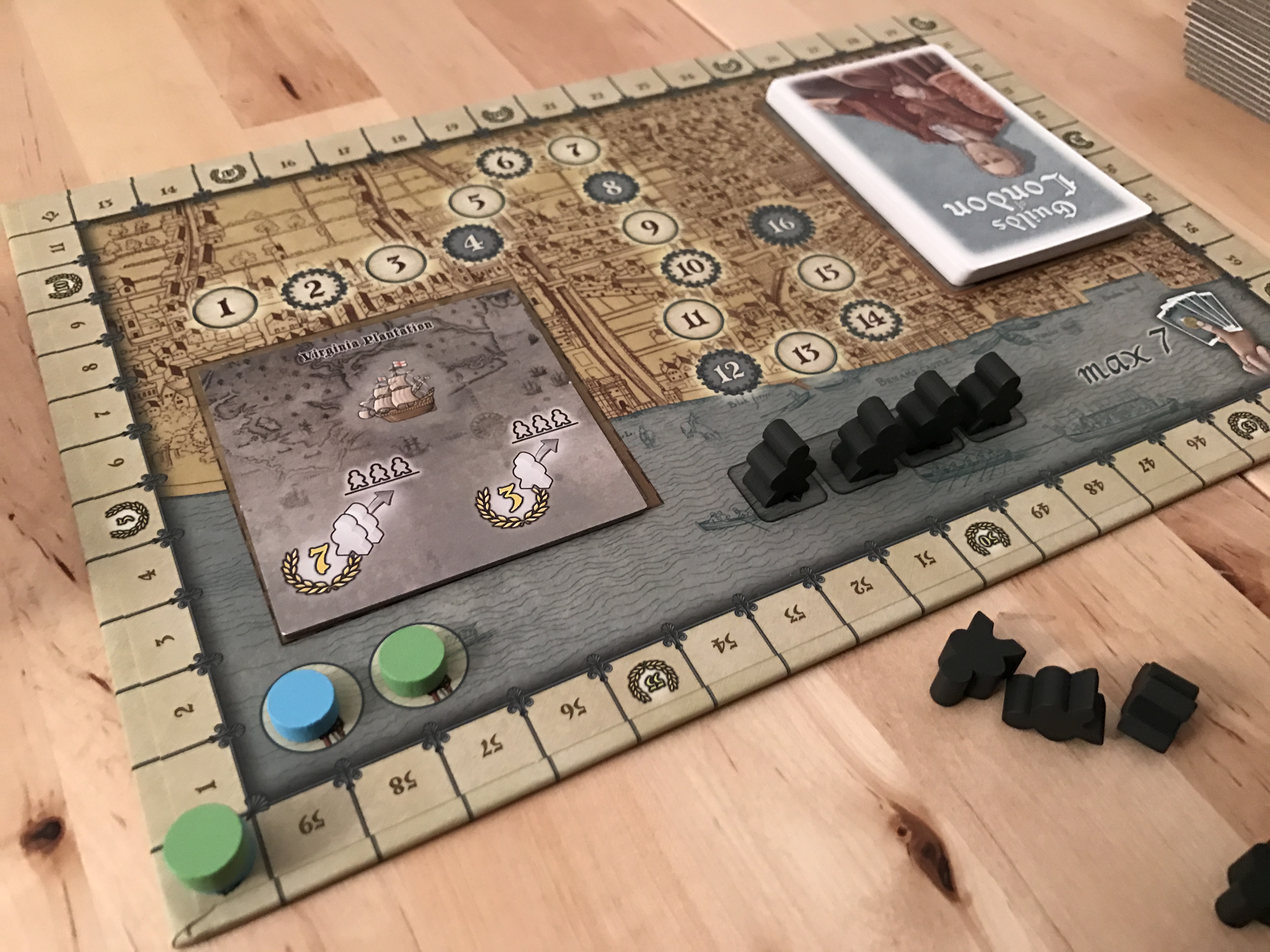
Finally, every third round, players will score a separate plantation tile that sits on the scoring board. Special powers allow you to move liverymen to this tile. Whenever a tile scores, the liverymen go back to the guild hall at the center of the board, but the plantation tile will send them back to the general supply. And then you’ll grow the play area, adding new tiles to the tableau so there are new spaces to fight over.
There’s more here, but the basic idea is that you’re fighting for majority, maneuvering your liverymen, and using your cards strategically to get the best results for your team.
It sounds brilliant, but how does it actually play? Let’s take a closer look.
What We Like About Guilds of London
First, there’s a lot to like about this game. I’m a sucker for any game that combines functions into a single resource. There’s a reason games like Race for the Galaxy, San Juan, and Glory to Rome play prominently in our top 100 list. It’s a brilliant mechanic and it forces you to make a lot of tough choices – spending great cards to perform mundane actions that matter.
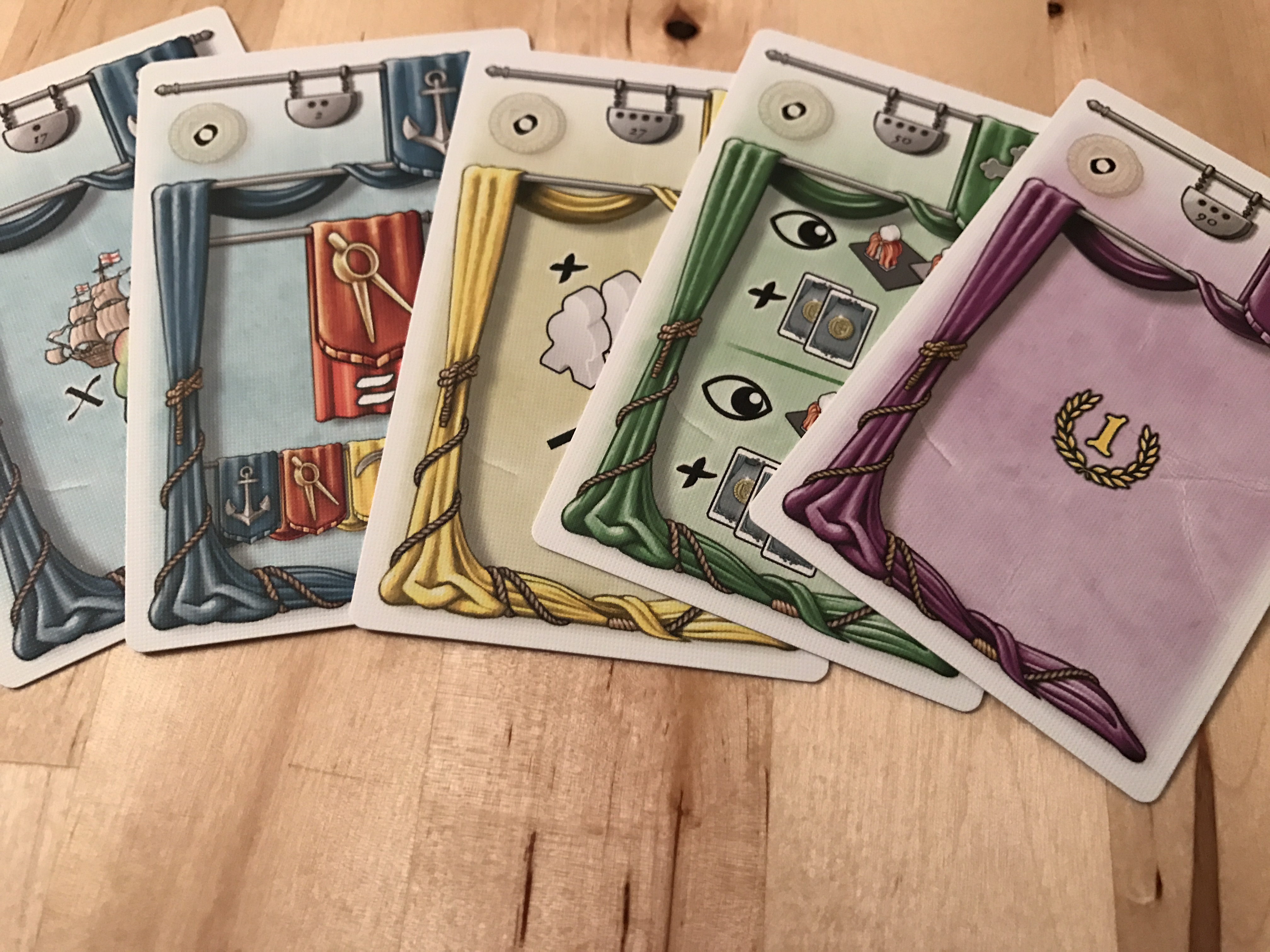
I am also a sucker for iconography, especially when it allows for dozens of possible actions and hundreds of combinations in any given game. Guilds of London has this in spades, with 40 guild tiles and 5 special tiles, of which you will only use a maximum of 34 in a game. Combined with a 21 possible Mayoral reward cards that impact your strategy and a huge deck of different actions cards, there is more variability in this game than most you’ll see all year.
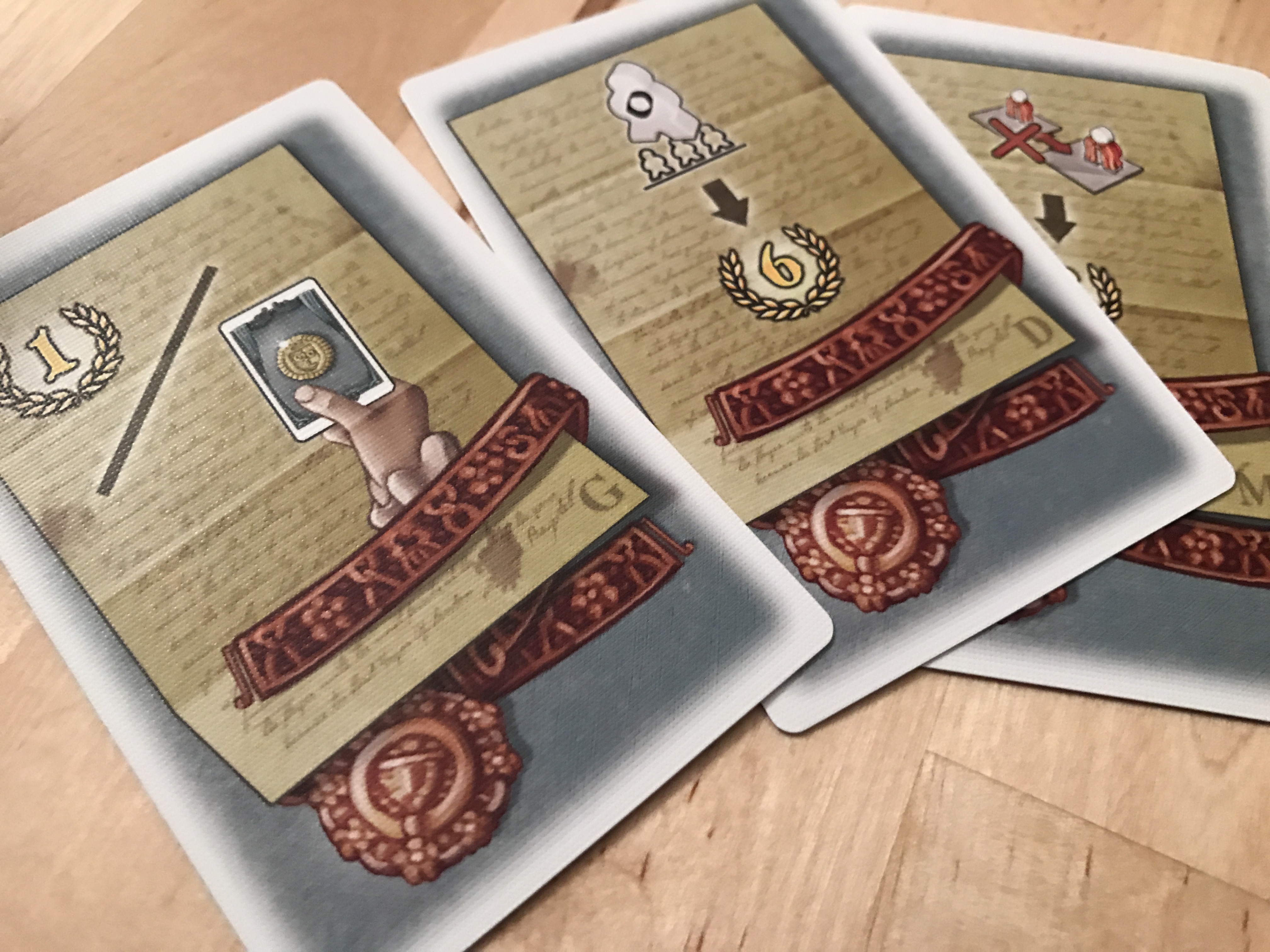
It’s a lot of fun to sort through the cards, evaluate your options, learn new paths to success, and generate combos that track across several rounds. The short rounds are also fun, allowing dozens of opportunities to try new things, and plenty of time to catch up if you make a mistake. This has everything I like about a robust, diverse euro, which is important for me when evaluating a game like this.
What We Don’t Like About Guilds of London
I wish I could stop there, because when I demoed the game, read the rules, and skimmed through the deck, I was enamored. So much so that it was an early stop at Gen Con just to ensure I got a copy.
But the truth is that Guilds of London has some issues. That iconography that I love has proven to be an immense barrier for new players. What should be a 90-minute game has thrice now turned into a 3-hour affair. With four players, it can take an interminably long time for every single player (many of them new) to check the double sided player aids on every single round to ensure they understand what the cards do.
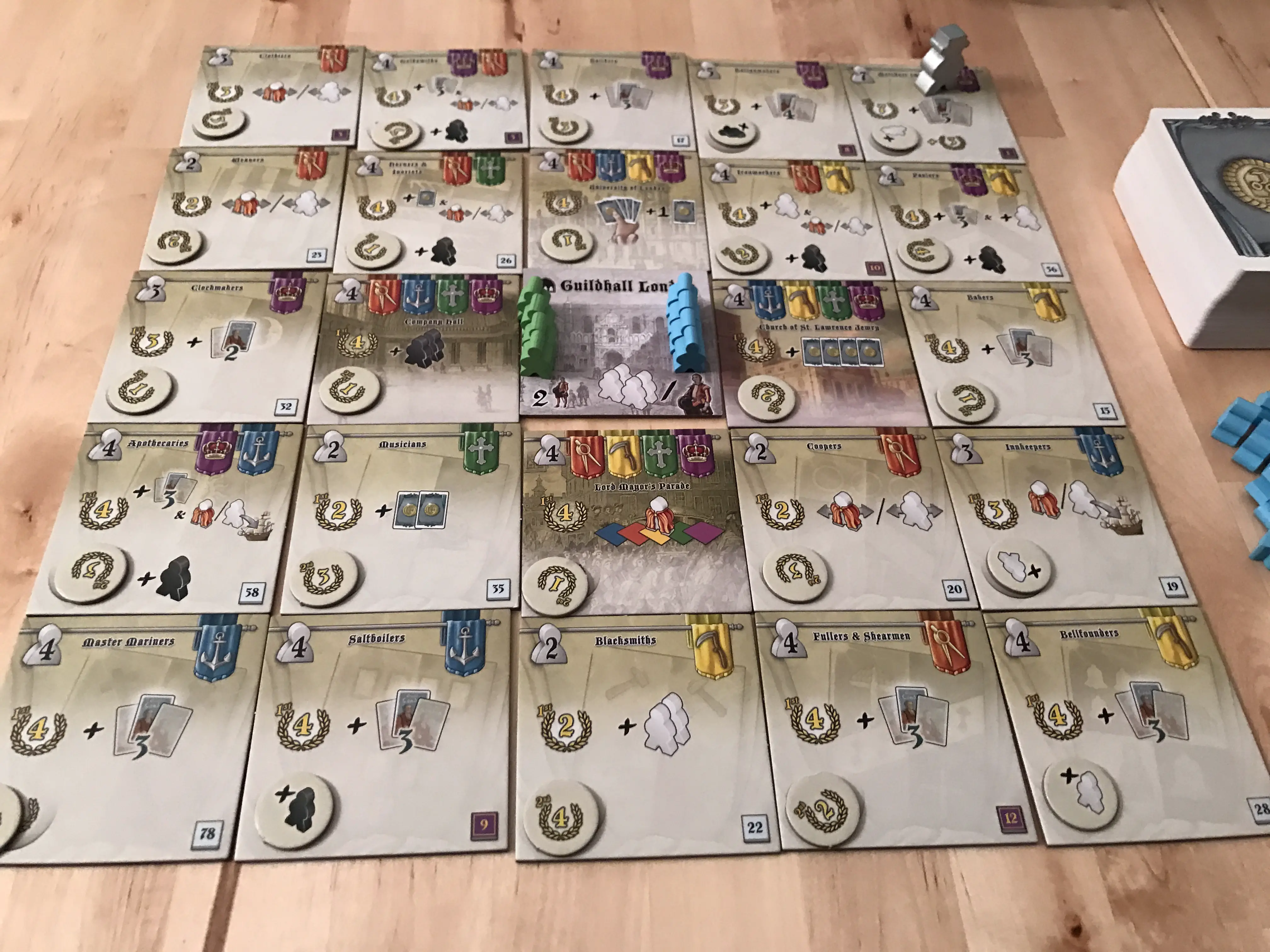
How long will it take for someone to memorize the icons and be able to play without aid? I reached that point toward the end of my third play. So if you don’t have a steady repeating gaming group, it will be a steep grind.
Another issue here is the fiddly nature of the game. There are a lot of bits and pieces, tiles that sprawl across the table and need to be flipped (which can be messy), and actions that vary from round to round. It’s very possible (and entirely likely) that you will forget to score the plantation or flip a tile or move liverymen to the right place after a resolution.
Are these issues game breaking? No, but they are a steep barrier to entry for new players, and a problem that a lot of people won’t be up for overcoming.
The Bottom Line
Guilds of London is a finely tuned, well-constructed, and very fun game once you know the rules and the abilities on the cards and guild tiles. But if you are stuck learning and teaching the game or if you play with new players often, the game is difficult to learn and can bog down.
The two and one player variants are good and go a bit faster (less than an hour once the icons are memorized), but play very differently from the 3-4 player version and it’s unlikely you’ll bring this out for 2 very often. If you’re a fan of icon-heavy, highly variable control games with strong strategic elements, you will certainly like Guilds of London, but beware of the learning curve.
