

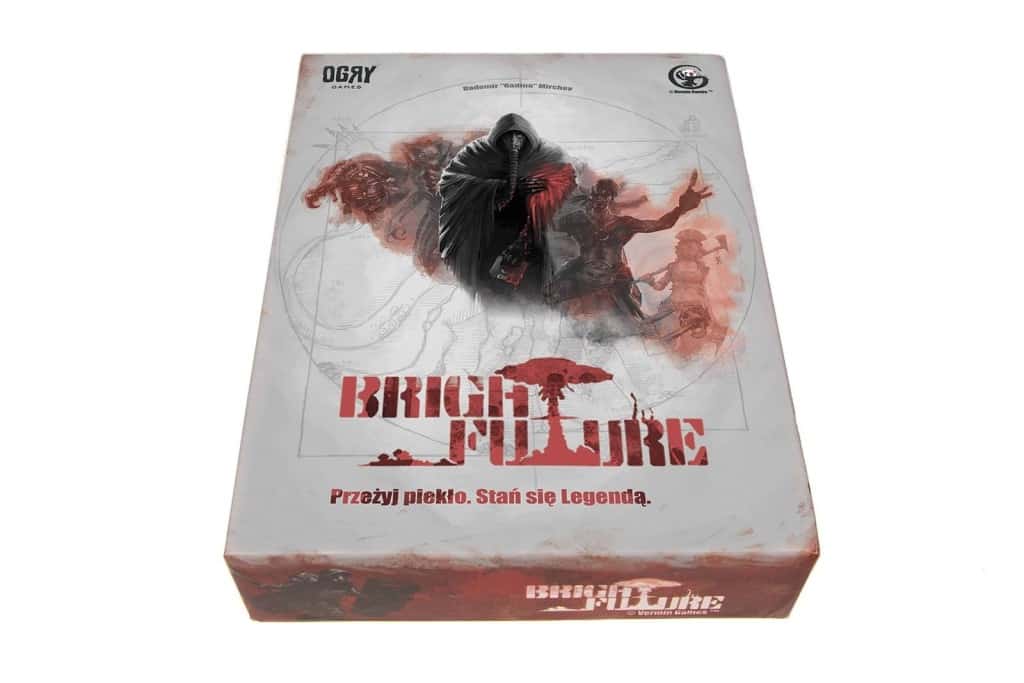
Bright Future (BGG link here) is a card-driven survival game for 1-5 players, designed by Radomir “Gadina” Mirchev and published by Vermin Games.
While not to the extent of Cthulu or zombies, we’ve seen more than a few new games with post-apocalyptic themes. For anyone who likes mutated denizens of dusty landscapes, titles like 51st State, Defenders of the Last Stand, Wasteland Express Delivery Service, and more have us covered.
Bright Future, kickstarted and delivered in 2015, perhaps goes further than any of the games mentioned above. It does a lot of narrative and worldbuilding work to bring us a fully realized, visceral experience of a post-nuclear future.
In terms of gameplay, Bright Future has more in common with a very recent, card-driven adventure game from Osprey Games, Lost Expedition. Both are fairly quick (at least at low player counts) survival games with card play and abstract map movement. In both, success relies on being able to navigate a system of symbol matching and resource management.
Where does Bright Future stand in the context of these other games I’ve mentioned? Considering that it’s a bit hard to get as I write this review in 2017, is it worth seeking out?

How to play Bright Future
Bright Future offers one competitive and one cooperative scenario. In the Tunnel of Power scenario, you can compete against fellow survivors in a race to open a bunker and attain safety. I will focus mostly on the cooperative Tunnel Fever scenario, where players work together to stop the spread of a disease that’s threatening what’s left of humanity.
In either scenario, players control individual characters from one of two factions – humans or mutants. Aside from some really gnarly artwork (especially for the mutants), the character factions differ in two important ways – what kind of items they could use, and how they interact with the game’s random encounters.

Each round of the cooperative mode consists of three phases, all of which flow from an event card. Good things usually happen in the first phase – triggering friendly encounters, enabling extra movement, and the like.

For the second phase, you move your character token along a card-based map that players reveal over the course of the game. You will encounter dangerous, irradiated anomalies, negotiate with friendly mercenaries, fight with unfriendly mercenaries, or visit settlements where you could make progress towards finding the ultimate cure. You might have multiple encounters during this phase, depending on what you face, how you manage your resources, and how much you want to push your luck.
In the third phase, the disease advances and becomes harder to cure. In order to cure the disease, players either have to gather disease codes from various encounters or else hire mercenaries to just shoot diseased members of your home base. Like in Dead of Winter, killing non-combatants in your home base is handled in an abstract way. In this case, you just move the population meter down.
Characters in Bright Future don’t have “health”, per se. The party as a whole uses the population meter as a group “health tracker” of sorts. Once the population meter hits zero, you lose the game.

Individually, each player has resource tokens that represent players’ ability to keep going through the tunnels. The resource tokens also act as currency to buy items. Therefore, whenever you visit a shop, you always have to balance buying a cool item with leaving yourself with enough spare resources to keep going.
The game resolves combat encounters through a system of symbol matching. You match the symbols on the enemies (representing different attacks like fire, melee, toxic, etc.) with those same symbols on your own item cards. If you can’t match the attack the enemy throws at you, you lose the difference in resources. If you ever hit zero resources, you “soft reset” by ending your current round and moving back to your base with your tail between your legs.
What I liked about Bright Future
One word: theme! Bright Future does an outstanding job of presenting a truly distinct spin on a post-apocalyptic story. Many games present the post-apocalypse in a cartoony style. Bright Future, however, delivers a gritty feel that evokes “underground survival” quite well. In addition, the game comes with a lorebook that describes the backdrop of the world, as well as that of the different characters. Normally, you could dismiss the lorebook as fluff. However, the designer clearly used the fiction around the game to drive it’s mechanisms.

The cooperative mode, Tunnel Fever, presents an engaging optimization puzzle for players to solve. Bright Future doesn’t have many event or encounter cards, so you can generally guess what’s coming. While I dislike seeing the same cards multiple times over a few plays in other games, I didn’t mind it here. Will you save up resources and try to buy your way to a cure? Or will you focus on recruiting mercenaries? Will you trade resources for rare items? That rare item might not be useful in you game. But then again, if you draw the right settlement card, you can trade rare item for something even cooler!
I also liked that the map cards add a spatial element to the puzzle.

Drilling down a bit, I found that Bright Future handled its internal economy of resources very effectively. You can get lots of stuff – generic resources, rice, rats, and other loveliness. Your gear also has lots of symbols that interact with the game in various ways. It took me a good while to jump over the conceptual hurdle created by so much different stuff. When I finished my jump, though, I found it all worked together very smoothly.
What I didn’t like about Bright Future
I did not talk much about Bright Future’s competitive mode. For a game with so much theme, I found pvp interactions between players very abstract. The symbol matching system worked fine when dealing with random mercenaries, but not between live players. Also, I felt that competitive mode didn’t do nearly as good a job conveying the story as did the cooperative mode. You could probably get your money’s worth playing only the cooperative/ solo modes.
As noted by nearly reviewer at release, the original rulebook did more harm than good. I highly recommend downloading the updated 1.1 rulebook from the Vermin Games website. Still, because all of the symbology created so many little interactions from turn-to-turn, I found that I needed to watch some video tutorials before I felt comfortable enough to get some plays in.

I mentioned at the outset that Bright Future reminded me of Lost Expedition, the most recent game that I know which mixes elements of survival, resources management, and an optimization puzzle with a spatial, map-based element. Lost Expedition does a great job of boiling down those elements into a series of very simple interactions. Bright Future, on the other hand, might have too much going on for what could (and probably should) be a simple card-based adventure.
I feel Bright Future shines brightest at low player counts – one to three players. Once players settle into a groove with the turn order, turns fly by fairly quickly. However, sometimes a player will hit multiple encounters in a turn, or they’ll pause a minute to consider their options at a settlement. I don’t think the AP in Bright Future is horrible. However, there’s enough to make a game at higher play counts drag a bit.
If the cooperative mode encouraged more interaction between players, then a higher play count wouldn’t be a problem. However, aside from trading items occasionally, it plays out like a multiplayer solitaire game. If you want the game for solo, however, then go for it!
Who is Bright Future for?
I really enjoyed my plays of Bright Future and intend to keep it in my collection. I adore how much effort was put into the post-apocalyptic theme – lore, art style, world building, and everything else. If I didn’t love the theme, I might not have stuck around to jump over the mental barrier presented by all the symbols, interactions, and (poorly explained) overall ruleset.
I’m glad I stuck with it, though. At the end of the day, I will play this game ahead of similar cooperative adventure card games.
