

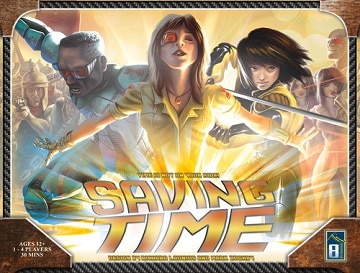
Saving Time is a family-weight cooperative game for 1-4 players, designed by Richard Launius and Mark Zoghby and published by 8th Summit.
When I see a game about time travel, I get mixed emotions. On the one hand, time travel! How cool is that? On the other hand, I’ve rarely seen time travel done well in a game. Still, hope springs eternal.
In Saving Time, you play time agents from the future, tasked with protecting humanity from an alien assault on time itself! Players will move around the board, play cards to deal with immediate crises, and also gather clues to eventually defeat the alien and win the game.
So let’s see… short term and long term goals, check… game space comprised by tiles, check… family-weight cooperative game, check… Hey, it sounds like Forbidden Island!
The basic mechanical actions in both games indeed line up very closely, as do their primary components (time tiles match up with island tiles, skill cards match up with treasure cards, etc.) Does Saving Time do enough with its theme and mechanisms to truly distinguish itself?

How to play Saving Time
The first thing you will notice about Saving Time is the 5×5 tile grid comprising the game space. Each tile represents a period in history, ranging from Ancient Babylon to the making of the Atomic Bomb. After every player turn, a special Crisis deck will prompt players to flip over one of the tiles on the board. That period in history is now in crisis! (Just like turning a tile over to its sunken side in Forbidden Island).
A tile in crisis present two challenges. First, you send “ripple” tokens out into neighboring tiles, which function as a ticking clock for other spaces to go in crisis as well. Not only that, but the tile itself could get completely destroyed if you don’t tend to it in some way. If you get five destroyed tiles (Void Tiles), you lose the game.

Players primarily use skills cards to fight back against the oncoming menace of the alien. Each skill card will depict one or two symbols. You can use your cards to, for example, fly to different spaces of the board or get rid of those pesky ripple tokens, one at a time. At the end of the day, though, you only really move towards winning when you can collect sets of these symbols and cash them all in at a crisis tile. If a particular crisis tile says it needs three influence (orange eye) and four strength (red axe), then someone has to go there and spend the cards in order to fix that tile.
Once you fix a tile, all sorts of good things happen. First, you get instantly teleported back to your home base (represented by a separate board) where you can draw back up to a hand of five cards. More on that one below. Second, you can choose either to take a skill token that will help you solve further crises, or to reveal one of the endgame cards. Each of the endgame cards, called alien cards, has a skill symbol. If you get enough skill tokens to match the alien symbols, you win the game!
Like in any good cooperative game, Saving Time allows you to choose from among a number of characters, each of whom has a useful special power.

I skipped over a decent number of minor mechanisms that players have to deal with. However, I think this is enough to give you a feel for the basic flow of the game.
What I liked about Saving Time
From the perspective of mechanisms, I actually prefer Saving Time over Forbidden Island for one simple reason. The hand management in Saving Time is way, way more dynamic and fun. Anytime you go to your home base, you draw up to five cards immediately. You can use an action to do so during the normal course of play, or you can ride the free teleport from fixing a crisis tile.
You can set up some really fun turns if you use the latter to its full advantage. Here’s an example. With three actions (the max you get on a turn), you can fix a tile, port back to HQ, and fill your hand back up (Action the First). Then, with your new hands of cards, you can fly directly to another tile in crisis (Action the Second). Finally, you fix another tile, port back to HQ and fill your hand back up again! So much fun, especially compared to Forbidden Island where trading and getting our sets together sometimes feels like a hassle.
Something else this game does that’s really small, but I think makes a big impact, is that the end of turn and event deck phases are lightning-quick. You don’t draw cards at the end of your turn like in Pandemic or Forbidden Island. Every once in a while, a player will mess that up and either forget to draw or overdraw. That means slowing the game down a bit to make sure everyone’s caught up. Instead, if you want cards in Saving Time, you have to use actions and/ or port to HQ.
In addition, you only ever flip one card for the enemy turn. The color coded tiles make finding and flipping the affected tile very easy. Less upkeep time = more time in the action = great!

Finally, I enjoyed my plays of Saving Time at all players counts. With four players, you can constantly have pawns on the board to make sure you have good board coverage. As a solo, you trade that for a bigger pool of cards in your hand to work with. Also, you can play with only one character and one set of cards! I really enjoyed being able to do that because classic coop games often make you play two characters.
What I didn’t like about Saving Time
Notice that, in my stuff I liked about Saving time, I did not mention theme. A time travel theme sets a high bar to have to jump over. I don’t think Saving Time did enough to clear it. None of the mechanisms scream time travel; the only bit of that you get comes via the pictures and names on the Time Tiles. This game could have been about saving paintings in a natural history museum, and it wouldn’t have made any difference.
In fact, I was disappointed by many different aspects of the Time Tiles. I did not enjoy the fact that they tried to use real pictures from real life. Many of them came out grainy and smushed. Art assets are expensive, but the publisher already commissioned pieces for the characters. As Ronny pointed out in his review over at Coop Board Games, the character and tile art really clashed.
Further, each tile had a piece of historical trivia on it. Some of the trivia wasn’t even trivia, but broad, sweeping statements that didn’t say anything interesting. In addition, I saw some grammar mistakes. I imagine the intent was to help families teach their kids about history. I don’t know that I would use this game for that.

From a mechanical perspective, I don’t have many criticisms of Saving Time beyond any criticisms that could be applied to any pure co-op, or particularly to Forbidden Island. Yes, it has a quarterbacking problem. Yes, it’s a bit puzzly. You also might have some games where you get killed by random, very unfortunate draws. As a lover of co-op games, I don’t mind these criticisms at all. But if you didn’t like Forbidden Island, I don’t know that there’s much here for you.
Final Verdict/ Who is this game for?
Despite my various issues with the production and overall design approach to the Time Tiles, I enjoyed my plays of Saving Time. If Gamewright had released something like this as a third installment of the Forbidden franchise, or as a variant of Island, I’d be really happy with it.
Admittedly, I pushed my grade up about a half-point or so because it played well as a solo. People who aren’t fans of pure coop and/ or solo can safely pass this one by. But if you like these kind of games, I think its’ mechanisms make it worth a look.
