

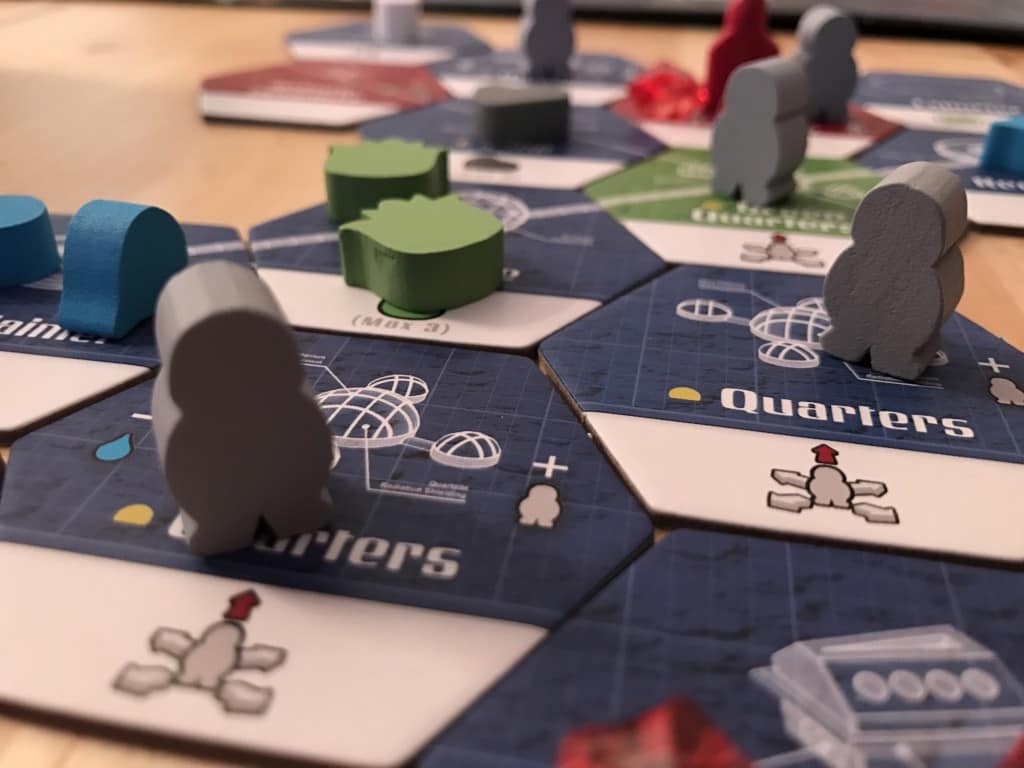
Lunarchitects is an interesting game for several reasons. First, there is the backstory. I was originally drawn to this game, not because of the theme or the visuals (both of which ended being spot on), but because it was a reimplementation of another game I rather liked and couldn’t find – Glen More.
Glen More was one of those hidden gems I had a chance to play at a convention and then upon realizing how great it was, was disappointed by its rarity (and subsequent cost). So, I don’t own a copy of the original. When Lunarchitects was announced, it was promoted as an homage and revamp of the Glen More formula.

Since then, there has been a fair bit of controversy regarding the input of the original designer, the publisher that still holds to the right to the game, and the new designer’s goals. I won’t use this forum to summarize all of that, but if you’re interested in the story, you can catch up on it at BoardGameGeek’s Lunarchitects forum.
For our purposes, this is an example of a barely funded euro with a fun theme and high production values that has a lot going for it, but unfortunately not a lot of people are currently able to get their hands on.
How to Play Lunarchitects
If you have played Glen More before, this is almost the same with only a small number of scoring-related changes. For those who haven’t played the former, let’s look at how it plays.
To start, each play will be building their own lunar base. They start with a hexagonal base of operations and one astronaut, plus three victory points (which act as currency as well). There is also a flip side to your base that provides variable starting resources.

The board consists of a rondel with several tiles on it and each of the player pawns, in order behind those tiles. Each turn, the player at the back of the line will move forward as far as they want along the rondel and choose one tile, paying the associated cost and taking that tile for their base. If the tile has a tunnel or rail on it, they must place it in a matching place on their base. If not, it should go where no lines would intersect it. The only other rule of placement is that an astronaut meeple must be adjacent to where you place your tile.
When you buy a tile, you will often receive a bonus of some kind. This happens only once. Additionally, the tile you place will activate, giving you whatever is listed in the white space at the bottom of that tile. Every tile adjacent to the newly placed tile will also activate, allowing you to chain placements together. Several tile types will produce resources which can be used to generate points, buy other tiles, or sell to the market for victory points.

You can also buy resources from the market for victory points if you need them, or play tiles that gain you crystals and rocket ships, both useful as currency in some cases or for scoring purposes.
Players go around the rondel four times, scoring each time they complete a lap. There is a lap scoring tile and two additional end game scoring tiles that you place randomly on the board at the start. There are also default scoring tiles that you can use already printed on the board.

And that’s it – the whole thing takes about an hour, plus maybe 5-10 minutes to teach, and while there is a slight learning curve as you get a sense of the difference between Early, Mid and Late tiles, the game is relatively straightforward.
What We Like About Lunarchitects
Matthias Cramer’s Glen More was one of my favorite games and one of the few in my top 50 that I don’t own, for printing reasons. Lunarchitects is not only a good replacement for it; it’s been streamlined and improved in several noticeable ways.
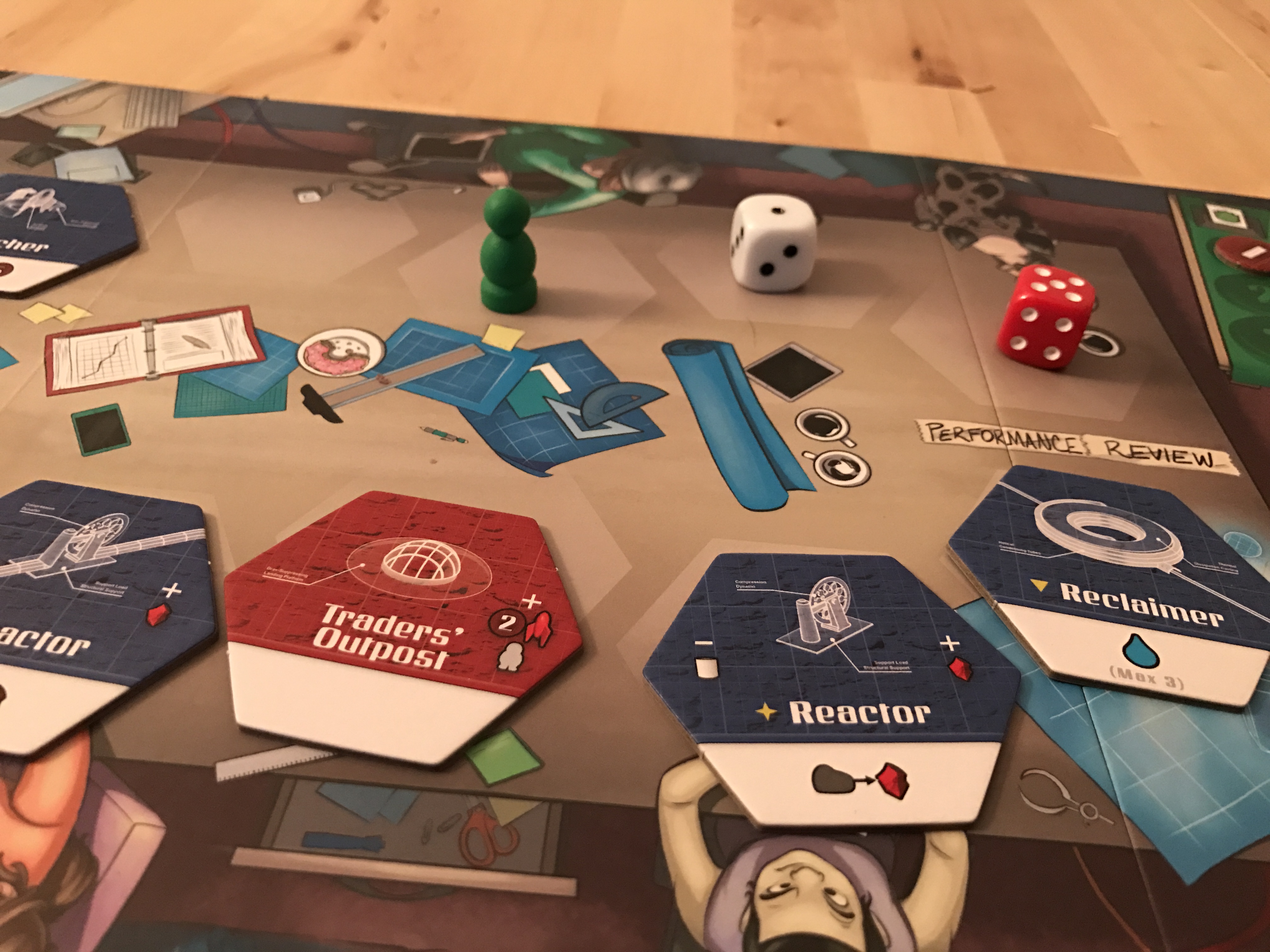
To start, there’s a dedicated solo mode, with two automa dice and custom scoring markers. The variable score tiles mean that every game will be slightly different depending on the scoring goals set out. And the introduction of the additional resources in the form of Rockets and crystals forces you to more carefully manage your resources throughout the game.
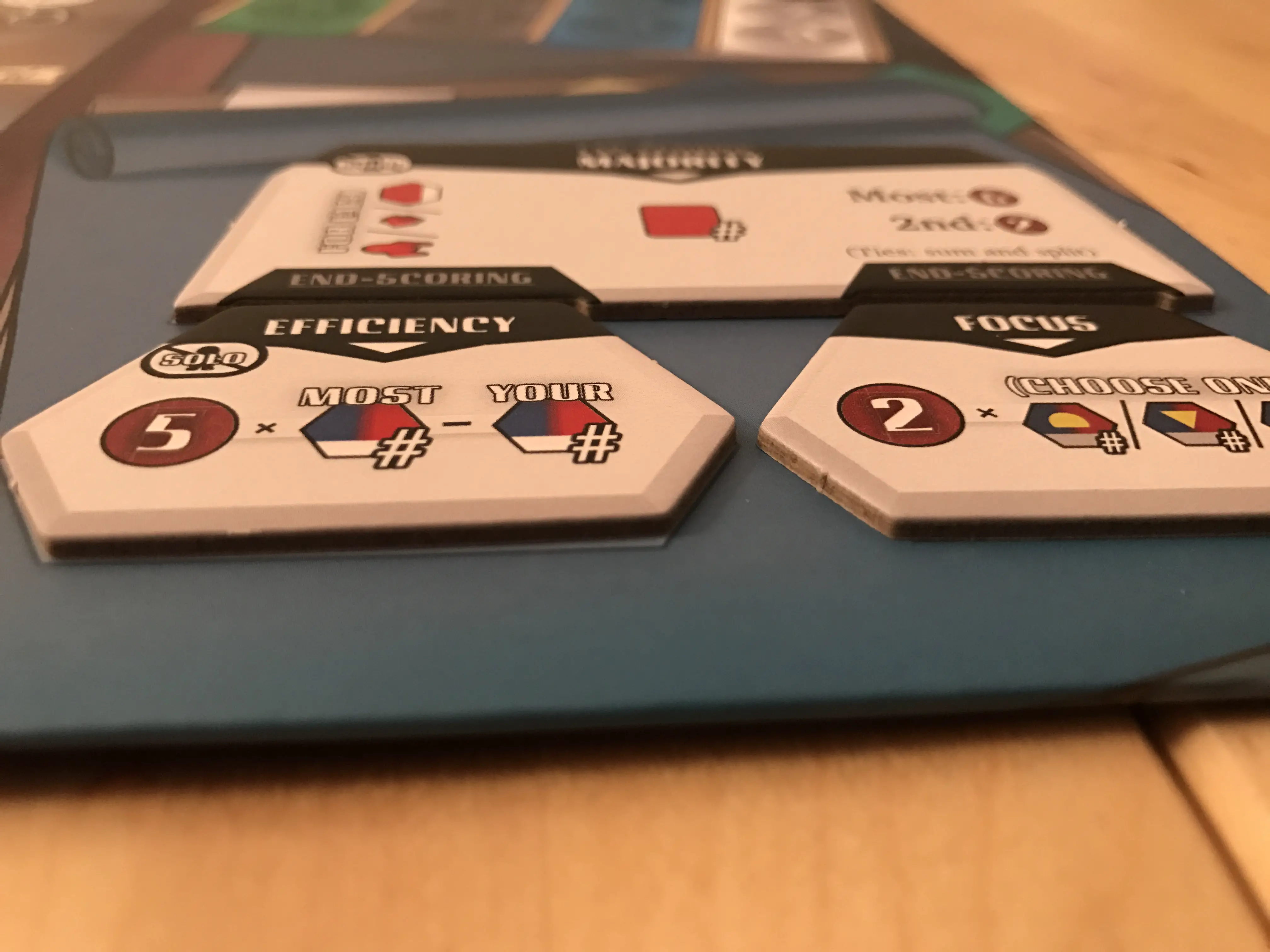 There are just enough new elements to make it feel like something wholly different, without abandoning the core of what made Glen More so much fun. The removal of the scoring based heavily on what your opponents do is also a welcome addition – while it kept the game tight, it would occasionally punish one player who went the wrong route early with their tile selection.
What We Don’t Like About Lunarchitects
It’s impossible to completely divorce this game from Glen More, if only because the two are very much the same game at their cores. And one of the rules removed from Lunarchitects that had a clear purpose is tile volume.
Because players would be penalized a number of points depending on how many more tiles they had than other players if they had the most, there was disincentive to sit back and maximize tiles. It made rushing ahead a decent strategy in some situations. In Lunarchitects, it just means you fall further behind. It’s an option, but not a good one, and for new players it adds a bit of a barrier to fun, especially if you get stuck waiting 15 minutes for your turn to come back around.
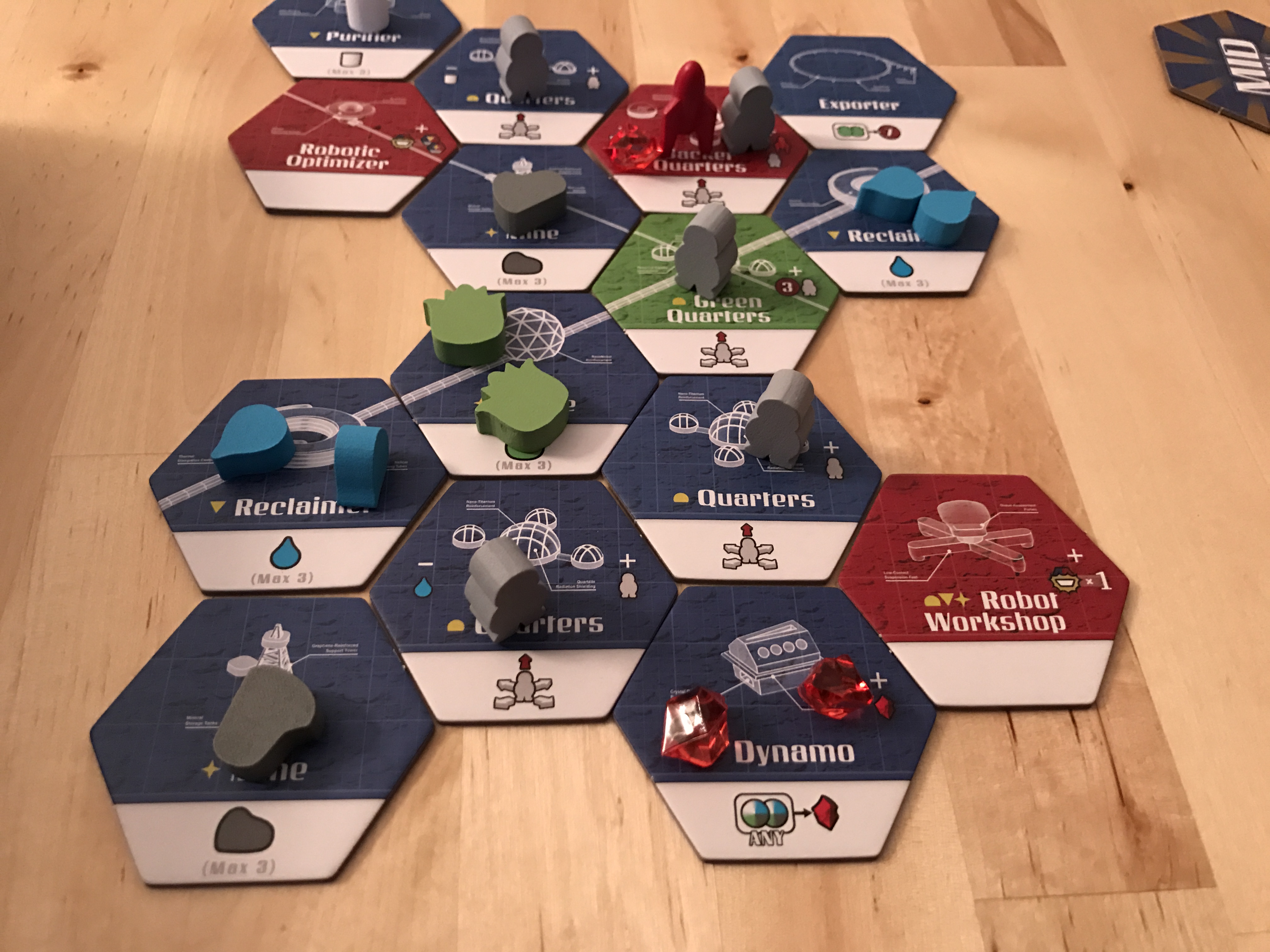
This is of course the nature of a rondel game, however, and one of the reasons it’s such a unique mechanic. Overall, Lunarchitects takes a good game and gives it a shiny new coat of paint and new features, but isn’t a wholly new game.
The Bottom Line
If you already own Glen More, there’s no real reason to pick this one up. It’s got some fun new things to it, but nothing so different that you need an entirely new game. But if you’ve never played Glen More or couldn’t find a copy (like me), this is a great way to play it, and the added solo rules and variable end scoring adds a lot that makes it feel fresh and exciting again.
