

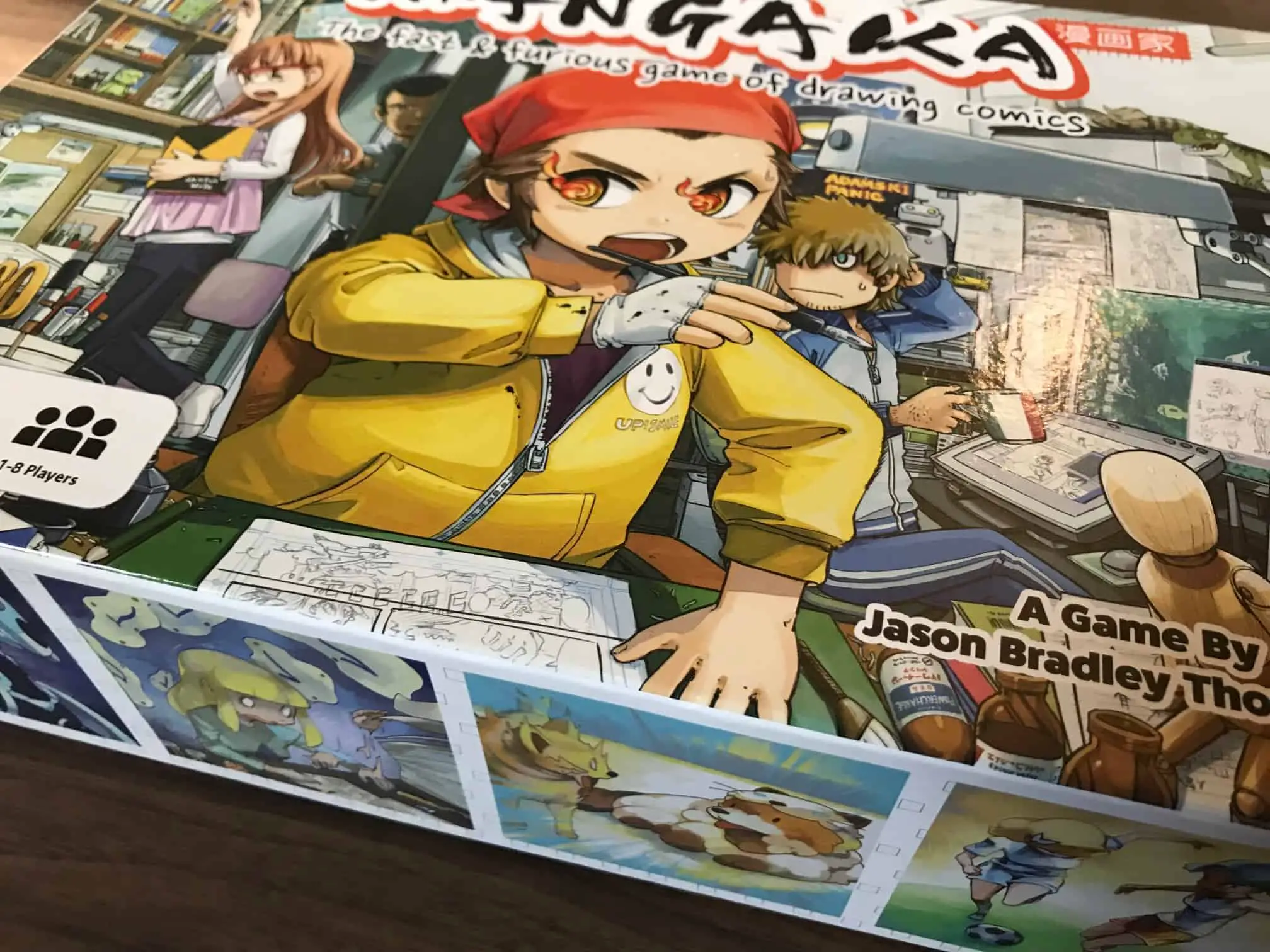
Disclosure: The designer provided a copy of Mangaka for this review.
Mangaka is a drawing game, and therefore, I shouldn’t rightly have any interest in it. I am, after all, objectively a horrible artist. I cannot draw, and have never pretended I could. Any game that asks me to do so in a competitive way tends to be infuriating to play, and I frequently lose.
With that out of the way, I can say honestly that I rather enjoyed Mangaka, because the drawing, while the primary mechanic, serves a deeper purpose and rewards quick thinking and problem solving in a way that not many party games do. Being able to creatively take the themes and trends presented and combine them into a clever narrative in a limited amount of time is difficult, but the hardest part is not the drawing, which means I have a fighting chance.
It’s this attention to the realities of games that so heavily rely on creativity, combined with a boat load of different cards to draw from that make this is a solid game with decent replayability.
How to Play Mangaka
Mangaka is fairly simple to play and can be done in about 40 minutes depending on the number of rounds you opt to play.
To start the game, each player draws three theme cards to determine what their personal comic will be about. There are a whole bunch of these in the deck – most of them are related to manga or anime in some form. Things like giant robots, sword fighting, and kaiju. There are some others as well that are a bit more general, but it’s all in the same general wheelhouse.

Players are then given five minutes to draw a comic in two panels that expresses those themes. You share them with the group, and they determine if you followed the rules – those being:
- Express your themes
- Use 3 or fewer word balloons
- Draw something recognizable in every panel
That last one can get tricky as time wears down, but you start to think and draw more efficiently as you go. If you pull this off, you get two fame.
In the following rounds, you’ll be pulling Trend Cards (things like Sci Fi, Sports, Fantasy, Shojo, etc.) that offer new ways to gain fame tokens, each of them with different winning conditions. You’ll also get more pages for your comic in subsequent rounds – going to 4 panels, then 6, and finally 8. As you can imagine, the growing number of Trends and panels, makes the game a fair bit harder (the timer sticks at 5 minutes).

It’s rapid fire, most of the drawings will get mighty close to breaking rule #3, and you’ll frequently feel stuck, but for a group that knows and loves Japanese pop culture, it’s a lot of fun.
What We Like About Mangaka
As I stated above, I am not an artist. So the idea of drawing things rapidly in an attempt to explain a story to people is not fun. But Mangaka was a lot of fun, if only because the core focus here wasn’t on drawing a story, but on conveying a certain number of points with a number of restrictions. It felt like Time’s Up, or something similar where you had to utilize not only your own skills, but the preconceptions of the audience. Obscure references no one gets could mean you lose points as people give you red marks for not following the themeing rules.

The game has a ton of variety in the cards as well. This is important for several reasons. To start, not everyone playing will have an encyclopedic knowledge of Japanese anime or manga. The cards aren’t horribly specific, but some are more in that wheelhouse than others. Removing things like “Shojo” or “Kaiju” that certain players may not know what to do with is possible because there are plenty of options in the box to choose from.
Will anime/manga fans have more fun, here? Absolutely, but it’s not a prerequisite to playing.

The timing of the game is good too. Five minutes of drawing in four separate rounds means that you get just enough time to get your ideas on paper, but not so much that you feel conspicuous in your lack of drawing ability (as most people will worry). It ends up being a solid 30-40 minute game, and there are plenty of opportunities to discuss and review comics without it dragging on too long.
What We Don’t Like About Mangaka
The biggest issues we had with Mangaka were ironically some of its stronger points. The variety out of the box made it difficult to ensure everyone felt comfortable with their topics (hence the changes referenced above).
For some players, the game went a big long, too. Not necessarily in terms of total time, but the amount of energy and investment required to frantically draw in five minute bursts, made that fourth round particularly tough (with 8 panels no less). Granted, I didn’t have this issue, but it’s one noted several times by other players, so is worth mentioning.
I personally didn’t feel the pressure to be a great artist myself, but did find the restrictions and added rules to grow cumbersome as the game went along as well. Trying to remember the three basic rules (several of us went over on word bubbles multiple times), the themes you’re drawing, and incorporating one or more of the trend cards each time, with the time limit and the growing number of panels got a bit overheated at times.
The Bottom Line
Mangaka is a fascinating take on a common mechanic that I frequently dislike. In the case of this game, though, it works, because it forces me to think creatively and strategically as I carefully manage my time and convey certain ideas in a limited amount of space. The rules can get a bit cumbersome towards the end, and some players will find the fourth round a bit much, but with so many unique ideas, and the chance to actually win a drawing game, regardless of ability, this is a fun experience worth trying, especially if you are an anime and manga fan.
